Trying out this idea I have, sharing what I’m reading while I’m reading it, instead of after. Because sometimes I’m reading five things at once, and I’m a mood reader, and some times I DNF, but regardless, I want to talk about what I’m reading, now.
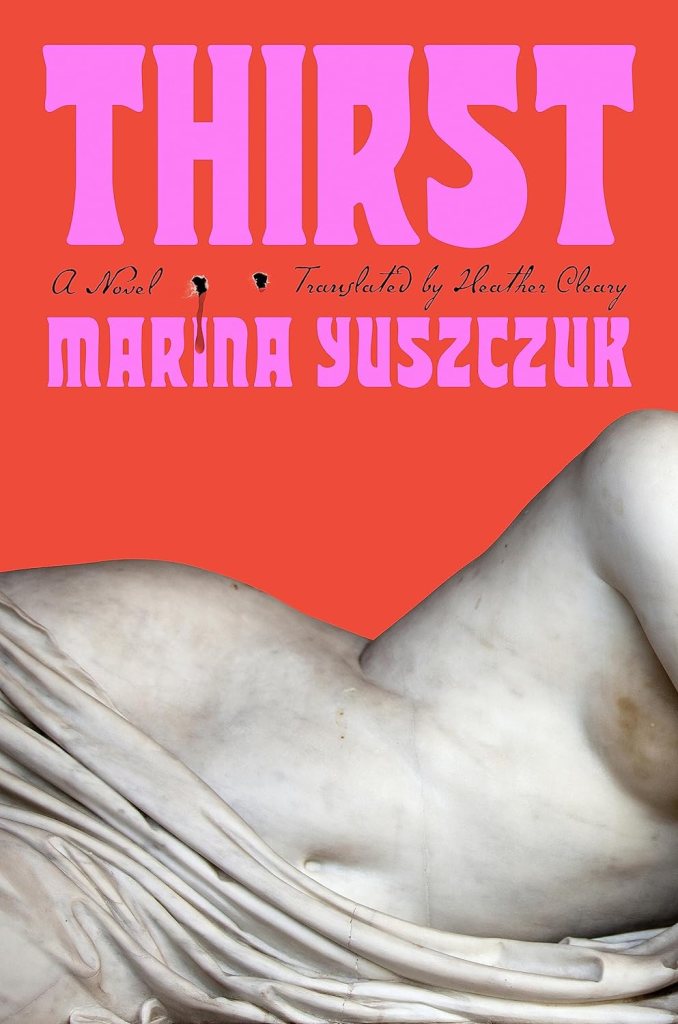
Thirst by Marina Yuszczuk
Setting: while it does switch around some in the first part of the book, eventually we end up in Brazil – Buenos Aires, early in it’s initial colonization. Then the story eventually centers on a cemetery.
There’s also a great deal of time being dealt with in this book. Centuries in fact. I think that’s pretty standard for most vampire or vampire-like books.
Vibes: this is a gothic horror for sure, and somewhat psychological. It also reads a little like an auto-biography. There’s a lot of exposition from the main character, Maria, and then another character later in the book.
Dialog: there is very little of it. The narrator is often setting the scene and describing the surroundings in very interesting ways. The prose are quite good in that regard. In my opinion, I think of the story as more of an aural history rather than something happening in real time. The main character, Maria, even states that she doesn’t have an understanding of time any longer. Her memories all drift together.
Additional characters: While this was billed as a sapphic vampire novel – at least that’s what I was initially told, it’s not. Well, it leans that direction certainly, but the main character has relationships with both men and women throughout the first part of the book. If you were going in for a pure sapphic blood lust vampire romance, this might not be your cuppa.
Part Two of the book starts off with a quote that hit me in the feels, and is particularly poignant right now with the state of the world. It reads:
“What do I do now?”
“Same as before. Keep getting up in the morning,
going to bed at night, doing what has to be done in order to live.”
“It will be a long time.”
“Perhaps a whole lifetime.”
– Ágota Kristof, The Proof (translated by David Watson)
The POV switches with Part Two and we understand we are with a modern woman who has a son and a friend named Julia. It’s the same POV as the woman from the prologue. The POV reads more like diary entries now, except for some conversations with her friend Julia.
Over all, I think folks that enjoy movies-in-your-head (you know who you are) while reading books, and can work with non-linear settings and plots, will likely enjoy this book for the vibes and the prose. There is sex in this book, but it’s not graphic, it’s thematic, if that makes sense. The book very much reads like a movie, at least to me it does, and I hope someone has optioned it – I’d definitely watch it.
For exposition haters: you’re not going to like this book at all. Don’t even try. It’s going to disappoint you. This is definitely a tell rather than show, and it’s not set up in the typical western three-act story arch. Thirst was translated from Spanish, and the name of the book was La sed. Based on other works I’ve read by authors that were translated from Spanish, this exposition style seems fairly common for most stories from the culture.
Personally, I’m enjoying the story. It’s compelling, and I’ll probably finish the book in the next day or two. (Currently on page 139 of 239)
Enjoy!
 Urban Fantasy Playground